Showing posts with label John William Tuohy. Show all posts

So Sixties.............

Birdland [The original Birdland 1949–65] Jazz Corner of the World - Broadway & 52nd Street, NYC

Charles Bronson, Steve McQueen  during production of John Sturges’s The Magnificent Seven (1960)

David Crystal - Fall 1963

Delta Airlines new offices, N.Michigan, Mr.and Mrs.George Stayman and Mr.and Mrs.William Hagenah, Dec 11, 1968.


Don Messick the voice of so many cartoon characters…

Downtown Las Vegas, early 1960 


Editha Duster in a dress by Nina Ricci.


FEB 8 1967 Aurora’s 18th Civil Defense Siren Goes up Siren is installed at E. Mississippi Ave. and Joliet St.

Flamingo Capri Motel. Las Vegas, c.1960.

Girls in racy fringe ensembles show off their moves at the Disc-Au-Go-Go, 1965

GOP Convention, Senator Dirksen , July 26, 1960

Hells Angels Biker, 1965 Photo Bill Ray

Holiday Inn Central - Denver, Colorado by Jordan Smith


Star Trek phaser will boldly fetch big bucks at auction


David Pierini

 A phaser prop from the original Star Trek series will be auctioned off next month. Photo: Propworx
A rare phaser pistol from the original Star Trek television series is “set to stun” when it goes on the auction block next month in Los Angeles.


It is made of fiberglass and one of only two known phasers to have survived the 1960s television series, which starred William Shatner and Leonard Nimoy as the leaders of the starship Enterprise.
The phaser could fetch more than $60,000, according to the website Luxurylaunches.com when it hits the block Feb. 21 during a Star Trek auction by Propworx.
Just whose’s weapon was this? According to auction house Propworx, it was likely used during several episodes of the second season. It has been visually matched to the March 29, 1968, episode “Assignment: Earth,” where a closeup shot puts it in the hands of a security officer in the transporter room.
A scratch and some small blemishes match the screenshot from the show and the prop up for auction. It was in the inventory of Star Trek’s production company, Desilu, before it went into the hands of a private collector after the series ended in 1969.
A page from the auction catalog shows a closeup of the phaser from a Star Trek episode and details visually matched to the prop up for bid. Photo: Propworx
Propworx serves the movie and television industry by selling off the assets of movie and TV productions. Its founder, Alec Petters, is known as one of the top collectors of Star Trek props and costumes.
While the old-school phaser is the jewel of the auction, fans can bid on 100 lots of costumes, props, models and other production materials from the Star Trek television franchise. Other items include a tricorder from The Next Generation series, a Klingon D-7 spaceship model, a Captain Sisko dress uniform and Klingon knives.
In 2013, a phaser rifle used by Shatner’s Captain Kirk was sold at auction for $231,000, according to Luxuryluanches.com.
Propworx has two other Star Trek auctions planned for this year. Interested bidders can sign up on LiveAuctioneers.com.


60's TV


                                                      The old Vulcan Mind Probe
Julia 
                                                                      Mister Ed

 Rusty Hamer played the son on the Danny Thomas Sow. His career later stalled and he committed suicide in 1990. Angela Cartwright, appeared in The Sound of Music and was Penny on TV's Lost in Space.  she’s a photographer.


                                                     Jay North is now 62 tears old

Donovan state prison inmate Sirhan Sirhan loses round in federal court


Kennedy assassin to remain in San Diego

By Matt Potter, Jan. 8, 2015

One of San Diego's most notorious inmates will remain behind the walls of the state's Donovan Correctional Facility here following a federal judge's ruling that evidence of a possible conspiracy does not absolve Sirhan Bishara Sirhan of guilt in the June 1968 slaying of Robert F. Kennedy.
The convicted assassin "has failed to meet his burden of establishing actual innocence," wrote judge Beverly Reid O'Connell in her January 5 order denying a bid by Sirhan for a writ of habeas corpus.
“Likewise, Petitioner has failed to demonstrate that he falls within the narrow exception warranting an evidentiary hearing at this stage."
The latest in a long string of legal efforts by Sirhan, now 70, was filed in May 2000. Despite multiple rejections by federal courts, his attorneys have continued to appeal the case, asserting in part that others were behind the killing of the Democratic presidential candidate.
"Though Petitioner advances a number of theories regarding the events of June 5, 1968," O'Connell's ruling says, "Petitioner does not dispute that he fired eight rounds of gunfire in the kitchen pantry of the Ambassador Hotel.
"After reviewing the evidence, the Court agrees with the findings of Magistrate Judge Wistrich. Petitioner does not show that it is more likely than not that no juror, acting reasonably, would have found him guilty beyond a reasonable doubt."
Much of Sirhan's latest bid for freedom has been based on testimony of eyewitness Nina Rhodes-Hughes, which was not presented at Sirhan's 1969 trial.
"What has to come out is that there was another shooter to my right," Rhodes-Hughes, a television actress, told CNN in April 2012. "The truth has got to be told. No more cover-ups."
O'Connell's ruling dismisses that argument. "Ms. Rhodes-Hughes disputes the location and number of gunfire shots; yet, importantly, she does not assert that Petitioner is innocent.
"First, Ms. Rhodes-Hughes’s recollection was recorded decades after the events took place, which calls into question its reliability. Second, her declaration confirms that Petitioner was a shooter that evening," the judge wrote.
"Ms. Rhodes-Hughes states that she was in the kitchen, she saw Petitioner fire his gun, and she witnessed men attempt to subdue him. Ms. Rhodes-Hughes does not state that she saw a second shooter.
“She suggests that there was more than one shooter because she counted twelve to fourteen shots rather than eight, and she testifies that gunfire originated in both the left and right sides of the room….
"Ms. Rhodes-Hughes describes how she fainted, was trampled by individuals in the kitchen, awoke with a wet dress, and had one shoe knocked off her foot.
“A jury reasonably may have concluded that witnesses could not be expected to pinpoint the exact location of those two parties in the midst of such chaos."
Questions regarding a second shooter and how many shots were fired have long dogged the case, but O'Connell's ruling rejected evidence presented by skeptics, including an audio tape of the assassination that one expert witness has maintained proves there were two shooters.
"At most, Petitioner creates a sense of doubt about the number of gunshots fired in the kitchen on June 5, 1968," said the judge, "but contemporaneous eyewitness statements do not support a second shooter theory."
Arguments that Sirhan was hypnotically programmed, perhaps by the Central Intelligence Agency or other anti-Kennedy government or mob actors, were also rejected.
Sirhan’s next legal steps have not been announced, but the latest ruling is unlikely to silence skeptics, who have included one-time San Diego Tribune reporter Robert Blair Kaiser and author of the book R.F.K. Must Die.
"I am more convinced than ever that Sirhan Sirhan didn’t think this up all by himself, and that he killed Kennedy in a trance," writes Kaiser in the epilogue to the 2008 edition of the book.
"Yes, that he was programmed to kill Senator Kennedy and programmed to forget he was programmed. Of course Sirhan was lying much of the time. He was programmed to lie. That was part of the cover-up.

"Of course, he was a psychotic when he killed Kennedy. His programmers induced the psychosis. But it only lasted for a time. Sirhan worked through that sickness (if you need to call it that) as he gradually came to see himself as an Arab hero, giving himself a sense of importance that he had never felt before." 

I had this game...I didn't like it, I didn't play with it.....but I had this game


TV dinners


Watts


The era known as 'the Sixties' really began in 1965


By JAMES T. PATTERSON

How 1965 changed everything
Lyndon Johnson's terribly mistaken Christmas speech of 1964
Fifty years ago Thursday, President Lyndon B. Johnson turned on the lights of the National Christmas Tree and proclaimed, “These are the most hopeful times in all the years since Christ was born in Bethlehem.” He continued, “Today — as never before — man has in his possession the capacities to end war and preserve peace, to eradicate poverty and share abundance, to overcome the diseases that have afflicted the human race and permit all mankind to enjoy their promise in life on this Earth.”
LBJ was by no means alone at that time in predicting such a glorious future. Millions of Americans were anticipating passage of Great Society reforms that he had been promising in his super-successful presidential campaign. The economy, having advanced steadily since 1961, was booming as never before. James Reston, chief political columnist for the New York Times, wrote on Jan. 1, 1965, that the nation was entering an “Era of Good Feelings.” Time magazine gushed that America was “on the fringe of a Golden Era.” It added that “the classic conflict between parents and children is letting up.”
These sentiments make one thing clear: Hindsight is far clearer than foresight. The rosy predictions of peace and societal goodwill came on the eve of the political, social and cultural turbulence — even violence — we now think of as “the Sixties.”
The Sixties didn't start in 1960. Rather — as the comments by LBJ, Reston, and others indicate — the years before 1965 were fairly stable. Most Americans in 1964 dressed as they had in the 1950s. Few young people sported beards or long hair. Colleges rigorously enforced parietal rules. Though the Free Speech Movement at UC Berkeley revealed rising restiveness among the young, the Students for a Democratic Society had only 1,365 paid-up members in December 1964. (The total rose to an estimated 80,000 by 1968.) Though white violence against civil rights advocates during Mississippi's Freedom Summer had angered many people, supporters of racial justice hailed passage of the historic 1964 Civil Rights Act — and of the War on Poverty — and remained committed to nonviolence and interracial cooperation.
Johnson's conviction that the nation was developing its capacity “to end war and preserve peace” seems particularly jarring, in light of both what was happening at the time and what would happen in the months following the speech. The previous August, Johnson had ordered bombing in North Vietnam following the Gulf of Tonkin “crisis,” but during his 1964 presidential campaign against Barry Goldwater, he had posed as an apostle of peace. In October, during the heat of that campaign, he promised: “We are not about to send American boys nine or 10,000 miles away from home to do what Asian boys ought to be doing for themselves.” Yet by the end of 1964, the United States had 23,000 “military advisors” in Vietnam, some 6,000 more than had been there at the time of Kennedy's assassination in November 1963.
American liberalism, the driving force behind much of what Johnson touted in his December speech, peaked in early and mid-1965. Driving a heavily Democratic Congress, the president secured a path-breaking Elementary and Secondary Education Act, expansion of the War on Poverty, and Medicare and Medicaid. Congress also approved a powerful Voting Rights Act, an innovative Higher Education Act, and long-awaited reform of America's then-racist immigration system.
But 1965 also brought the start of the tempestuous Sixties. Following a Viet Cong raid on an American base in early February, LBJ authorized round-the-clock bombing (Operation Rolling Thunder) of North Vietnam. A month later, combat Marines landed at Da Nang. At the same time, on Bloody Sunday (March 7), white police and troopers savaged peaceful marchers in Selma, Ala., thereby enraging millions of Americans. In late July, LBJ announced a massive escalation of American forces in Vietnam. In early August, five days after he signed the Voting Rights Act, blacks in Watts erupted in violent protest. Many whites, shocked, began to wonder about civil rights activism. The movement was never the same thereafter.
During the next few months, much of the optimism that had prompted Johnson's grandiloquent remarks in December 1964 began to fade. Political polarization was widening. Black leaders in the Student Nonviolent Coordinating Committee were moving toward what became known in 1966 as black power. Antiwar protesters were starting to burn their draft cards. On the right, conservatives launched increasingly vocal attacks on the War on Poverty and on Big Government. Ronald Reagan, very much in the headlines, was readying a successful run for the governorship of California in 1966.
Developments in popular music reflected this more unsettled mood. In June, the Rolling Stones released “(I Can't Get No) Satisfaction,” whose lyrics were more sexually explicit than those of other pop hits of the day. Described by fans as “an anthem for a generation,” “Satisfaction” soared to the top of the charts. A month later, Bob Dylan “went electric” at the Newport Folk Festival, thereby hastening a trend toward folk-rock. In September, Barry McGuire's “Eve of Destruction,” a raw and explicitly topical protest song, reached No. 1.
By the end of 1965, 184,000 American troops were stationed in Vietnam, and casualties were mounting. Inflation, much of it caused by the war, was worrying economists. When LBJ turned on the lights of the National Christmas Tree in December, he had nothing uplifting to say. Events in 1965 had launched a series of transformations — many of them rancorous and divisive — that sharpened during the Sixties that followed. Fifty years ago, a new era was arriving.
James T. Patterson is an emeritus professor of history at Brown University and the author of "The Eve of Destruction: How 1965 Transformed America."


'Beverly Hillbillies' actor sues CBS over chain


DES MOINES, Iowa — The actor who played Jethro Bodine in the 1960s television series "The Beverly Hillbillies" is suing CBS, arguing the broadcaster made inappropriate deals with an Iowa restaurant chain to use the character's name.
Max Baer Jr. filed a lawsuit Tuesday arguing that he had reached a deal with CBS in 1991 giving him rights to use the TV character to establish a chain of restaurants, hotels and casinos.
The lawsuit contends Baer's rights to the character have been undermined by the Jethro's BBQ restaurant chain, which is based in Des Moines.
Bruce Gerleman, the chain's owner, told The Des Moines Register (http://dmreg.co/1Ba4YLS ) the company isn't named as a defendant and that customers have nothing to worry about.
"We own the name, we own the trademark, it will always be Jethro's BBQ in Des Moines, Iowa," he said.
A CBS spokeswoman said it has made great efforts over the years to try to amicably resolve the issue with Baer and will continue to do so.
Under the agreement between Baer and CBS, the actor has spent up to $1 million in efforts to develop his business, the lawsuit states. Baer also has paid royalties to CBS for merchandise, including revenue from themed slot machines and a brand of BBQ sauce.
Baer's attorney, Jon Freis, said his client was "kept completely in the dark" about negotiations between the broadcasting company and the Iowa businessman over the chain restaurant.
Jethro's BBQ opened in 2008. CBS contacted Gerleman saying it owned the rights to the TV character and other themes from the show. The parties reached an out-of-court agreement, and Jethro's BBQ changed certain features of restaurants, including food dishes named after some characters.


Mr and Mrs. Disney


Paul Newman and Anthony Perkins, 1961.


Lawrence of Arabia


Jack Lemmon


The last few prisoners of Alcatraz leave as the prison is shut down for good. [1963]


Neil Armstrong photographed by Buzz Aldrin, shortly after walking on the moon. [1969]


Pan AM economy class 1964


Dartmouth 1966


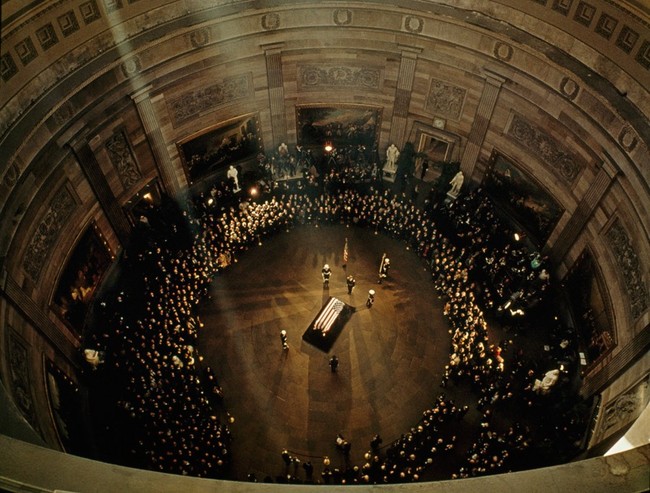
Bird’s eye view of JFK’s funeral in the Capitol Building. [November, 1963]


Alvin


East and West

A crowd of West Berlin residents watches as an East German policeman patrols the Berlin Wall in August 1961.

An over the shoulder view of JFK’s “Ich bin ein Berliner” speech. [1963]